

When a real war in the Middle East manages to blur a domestic institutional scandal.
“Wag the Dog” is an expression that, in its broadest sense, describes a situation in which a secondary event ends up controlling or overshadowing the main one.
In this case, however, we are witnessing a reversed — and distinctly Greek — version of the phenomenon.

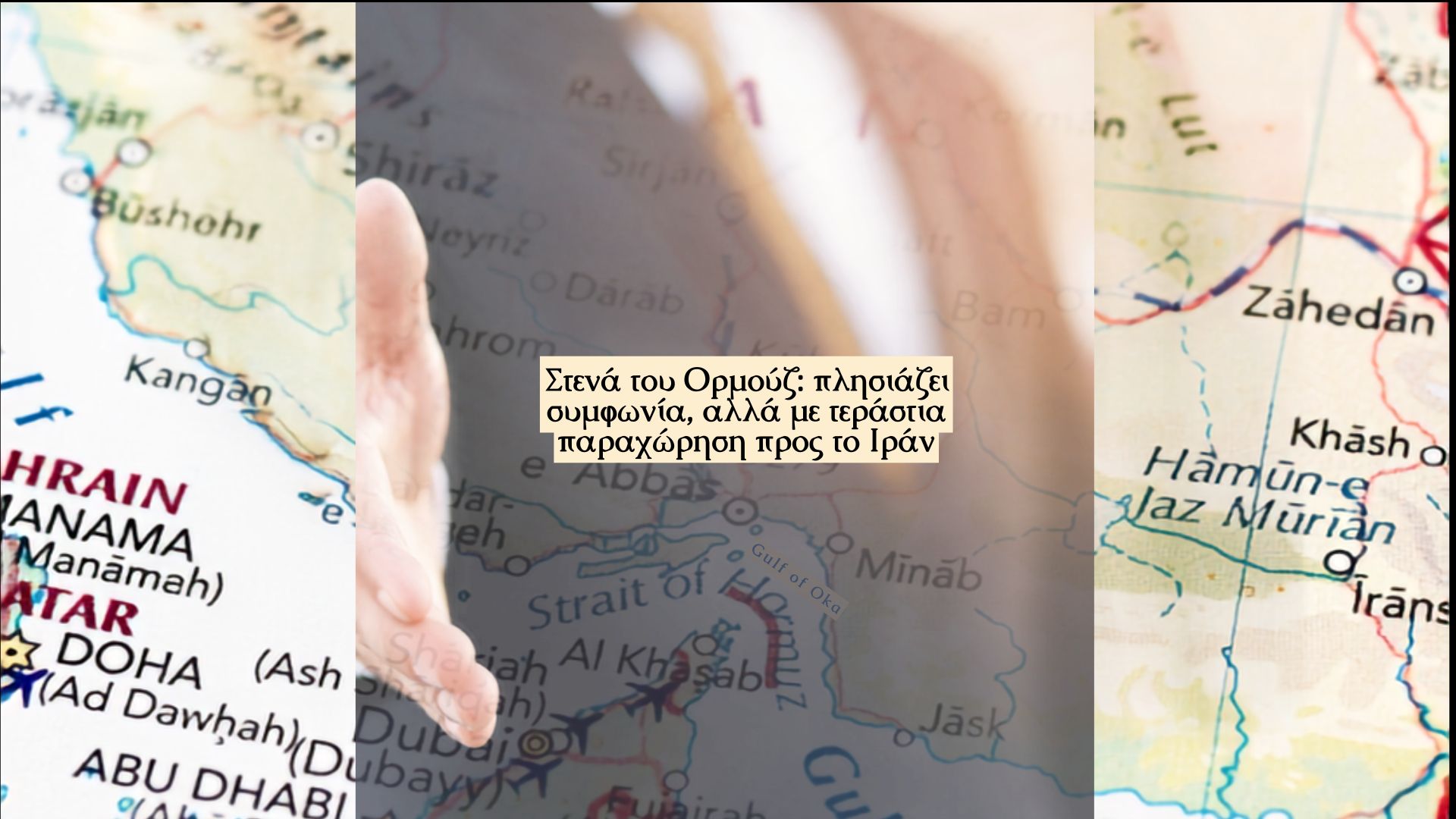
A real war in the Middle East suddenly becomes the backdrop that obscures the first judicial conviction related to Greece’s illegal surveillance scandal.
Under one working assumption, the war in the Middle East may also function as a political “lifeline” for Donald Trump amid the broader deadlocks of Western political leadership.
Economic crises tend to expose systemic weaknesses. Military conflicts and geopolitical crises, by contrast, often help conceal them. They generate such an overwhelming level of political and media noise that the internal contradictions of political systems are pushed into the background.
The renewed war in the Middle East is currently playing exactly that role for much of the Western world.
At a moment when Western democracies are facing deep institutional and political tensions — from a crisis of representation to declining trust in the media — geopolitical escalation becomes a kind of political refuge.
Within this context, every new escalation in the Middle East, with Israel at the center — a state that, institutionally speaking, is not formally part of the Western alliance system — turns into a test for Western political leadership.
Governments are forced to balance between strategic alliances, domestic political pressure, and the international legitimacy of their decisions.
This dynamic is reinforced by the broader sense of political fatigue that characterizes much of today’s Western leadership.
In the United States, the government often appears trapped between internal political polarization and an increasingly complex international environment.
In Europe, many governments face economic pressure, social discontent, and the rise of populist movements.
Within this vacuum, Trump’s political narrative — the idea that the West can regain control through a more aggressive and simplified strategy — gains renewed traction.
This is not necessarily a realistic political proposal.
But it is a narrative that resonates with societies exhausted by the management of continuous crises.
Meanwhile, in Greece, the recent first-instance conviction of four individuals in the illegal surveillance case represents the first substantial judicial development in a scandal that for months had been treated by much of the political system — and a significant portion of the media — as a secondary issue.
External crises often serve as instruments for the reconfiguration of political authority.
Geopolitical tension creates a sense of urgency and allows governments to shift public debate away from domestic problems toward questions of international security.
The Greek case: when war covers a domestic fracture
While news bulletins and international headlines are filled with images from the Middle East, something happened in Greece that under different circumstances would likely dominate the national political conversation.
Greece therefore offers a characteristic example of how international developments can reshape the internal political agenda.
The recent conviction of four individuals in the illegal surveillance case constitutes the first meaningful judicial ruling in a scandal that for months had been politically downplayed.
The court recognized that the defendants played an active role in illegal monitoring operations involving the use of malicious spyware — a finding that raises a fundamental question: whether a parallel surveillance mechanism was operating outside the institutional framework of the national intelligence service.
This ruling does not close the case.
On the contrary, it opens a new chapter.
For the first time, the institutional system acknowledges that such mechanisms cannot be explained as isolated incidents or technical deviations.
The first conviction creates a fracture.
Through that fracture may now emerge:
new judicial investigations
political accountability at higher levels
a reassessment of power relations within the media landscape
renewed scrutiny from European institutions
and the return of the surveillance scandal to the national political agenda.
Brussels will speak again.
And this time, most likely, in harsher terms.
The role of the media
In every major political crisis, the role of the media proves decisive.
In the United States, the Watergate scandal was exposed largely thanks to the persistence of The Washington Post and the pressure its reporting exerted on the political system.
In Greece, the picture has been different.
For a long period, a large part of the media treated the surveillance scandal with caution — or silence.
Only when the judiciary began producing concrete rulings did the issue return forcefully to public debate.
This is not merely a journalistic issue.
It is a sign of a deeper crisis of trust between society, politics, and the media.
The central question that emerges does not concern Greece alone.
It concerns Western democracies as a whole:
Can their political systems confront their internal crises while simultaneously facing major geopolitical challenges?
The answer to this question will shape the political trajectory of the coming decade.
Because if history has shown anything, it is this:
The deepest fractures of democracies do not arise only from external conflicts.
They emerge when societies begin to doubt the functioning of their own institutions.
And when that happens, the crisis ceases to be merely geopolitical.
It becomes institutional.