



THE HERMIS n&m
NOÈMA · NEWS & MESSAGES
THE HERMIS → ΕΝΟΤΗΤΑ → ΑΡΘΡΟ
US–Canada–Europe: a politically uncomfortable comparison of strategic relationships and sovereignty
We do not yet know whether Carney will win. But that does not change the basic fact: his government has drawn a line. "This far!"
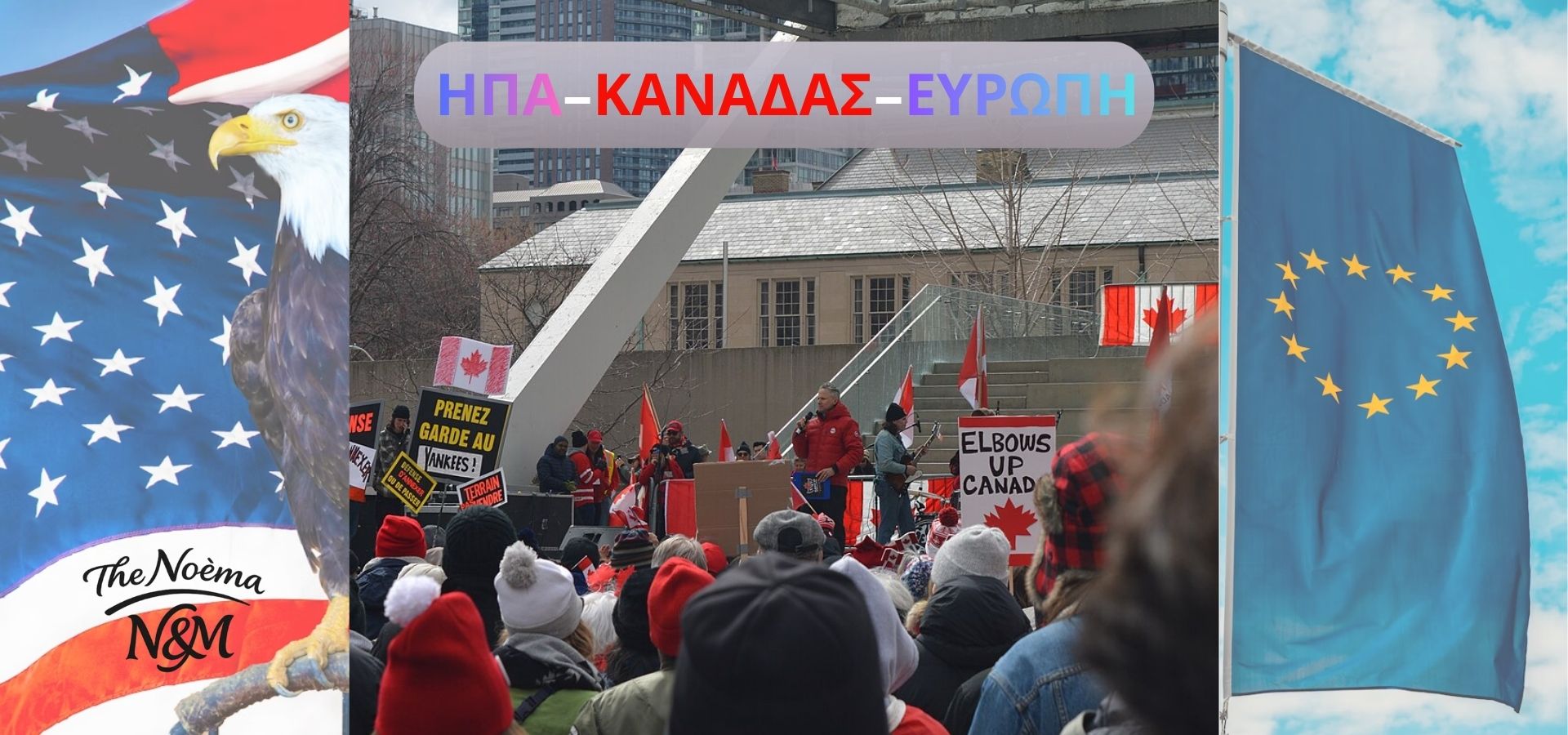
UPDATE | 31.08.2026: The US–Canada confrontation continues to escalate. Washington has announced an increase in tariffs on Canadian cars from 25% to 50% from January 1, 2027, while trade talks remain deadlocked. The development reinforces the central question of this piece: how much cost is a state prepared to bear when it believes its room to pursue an independent policy is at stake?
Canadian Prime Minister Mark Carney is perhaps the last person one would choose for the role of a politician challenging the certainties of the globalised economy.
He came through central banks, international financial institutions and Brookfield. He is very much a man of a world built on the free movement of capital, economic interdependence and the belief that economism, markets and institutions are society’s Holy Grail — often above political thought and sociological necessity.
He is not anti-system. He is not a populist. He did not wake up one morning and say “f@@@@ Wall Street.”
And yet, when American pressure reached the point where Ottawa believed it was no longer negotiating only tariffs but also its room to exercise independent economic policy, Carney did something extremely “old-fashioned”:
he said “no”, knowing that “no” would cost — following a deeply Canadian political understanding that proximity to the United States does not erase a distinct national identity: Canadians first, not “North Americans” on American terms, and in any case not Americans.
And he did not stop there. The Canadian government accompanied the retaliation with specific billions in public support for businesses and workers who will be hit.
In other words, the government said, more or less, that “we are choosing confrontation, we know there will be casualties in the economy and we are politically taking on part of the bill.”
This is where the truly uncomfortable comparison with Europe begins.
What, eighty years after the Second World War, keeps Europe’s political leaderships so tightly bound to the United States?
After Maastricht: economic rationalism as a substitute for strategy
After Maastricht, Europe took a huge step toward economic integration.
Single market, common currency, free movement of capital, common rules, increasing regulatory integration.
Gradually, however, economic rationalism ceased to be simply a tool and became almost a political worldview.
Interdependence was treated as a factor of stability. Rules were elevated into a kind of gospel for the mechanistic management of arbitrariness — strict or flexible, depending on the subject. And the famous “market of 450 million” began to be treated almost as self-evident proof of power.
Except that 450 million Europeans do not constitute a single state. The same market contains countries with different productive strength, different fiscal room, different energy needs and often different geopolitical priorities.
The only real “weapon” was Europe’s economic power. But as the years showed, converting it into a single political will was... a different gospel altogether.
From here on begins a merry-go-round of “difficult” questions...
Europe paid. But who exactly paid?
After the Russian invasion of Ukraine, Europe, as a single political whole — one way or another — moved rapidly away from Russian natural gas. This choice is often presented as proof that the EU can, when necessary, pay the cost of a strategic decision.
Except that this reading skips the most critical question: who exactly paid?
Because the energy cost was passed to a significant degree onto households, businesses, inflation and national governments, which were forced after the fact to deploy subsidies, caps, tax relief and marginal support mechanisms. Fuel is a characteristic example: today VAT remains at 24% in Greece, 21% in Spain, 20% in France and 19% in Germany, while where temporary tax cuts or targeted subsidies were introduced, they functioned mainly as measures that absorbed only part of the shock. And all of this, in relation to the total energy cost transferred to the real economy, was crumbs. This was not the strategic cost being taken on by a single European political centre, but fragmented national interventions while most of the bill ended up in consumption, business operating costs and the loss of real income.
No single European political centre appeared and said:
“We choose this strategy. This is its total cost. And this is the common European mechanism through which we will protect those who will pay it.”
The cost was socialised unevenly and, even more importantly, the strategic direction was not formed in a political vacuum.
Europe faithfully and without protest followed the Western line shaped under the Biden administration: economic decoupling from Russia, sanctions, restriction of energy ties and a dramatic increase in LNG supplies from alternative sources — primarily the United States.
Dependence on Russia was indeed reduced, but it was simply replaced by another dependence.
And therefore the question is not whether Europe has the capacity to bear costs, because it has already borne them.
The questions are: “who decides when it will bear them, for what strategic purpose, and who ultimately pays the bill?”
The truly uncomfortable paradox
A few years later, when the pressure came not from Moscow but from Washington, the behaviour changed.
The Trump administration imposed new tariffs and demanded a new economic relationship with Europe.
And Europe, despite the size of its market, despite its economic weight and despite the trade countermeasures available to it, accepted the pressure in an appeasing mood without a corresponding confrontation.
Neither dollar-for-dollar, as Canada did, nor even a political “shot” simply to make clear that there is a price.
And somewhere here appears the question that is much larger than any tariff:
What, eighty years after the Second World War, keeps Europe’s political leaderships so tightly bound to the United States?
And so a Union of 27 states and roughly 450 million people often seeks strategic coherence together with a country that chose to leave the Union itself(!) — and which, from 2016 to today, has changed prime minister seven times(!).
There is no single answer. There is a web of dependencies, historical choices and political habits that has hardened over decades.
There is the American military umbrella.
There is NATO and the postwar security architecture.
There is the dollar and the position of the United States in the international financial system.
There is technological dependence on American platforms, cloud, software and critical infrastructure.
There is the political culture of decades in which the transatlantic relationship ceased to be treated as one alliance among allies and began often to function as the self-evident framework within which European strategy is defined.
And there is something even harder to measure: the pathological self-indulgence of part of Europe’s political elites, who for decades learned to function inside a protected framework without having to assume the real cost of an autonomous strategic choice.
And right there is reflected the deeper deficit: the absence of political leadership willing to challenge the embrace with the United States when it believes European interests diverge from American ones.
Who carried Europe after Mitterrand and Kohl?
The question is harsh precisely because it is not only about institutions.
It is about people and political weight.
Before Mitterrand and Kohl, there was Charles de Gaulle — perhaps the clearest postwar European expression of the idea that alliance with the United States must not mean strategic submission.
Gaullism placed national sovereignty and autonomy of decision above all else. De Gaulle’s France did not want to leave the West. It wanted to be able to belong to the West without automatically obeying Washington.
At the same time, Gaullism itself was deeply nationalist, often chauvinistic, and rested on a powerful conception of French grandeur. The “Europe of nations” he envisioned was not a federal European democracy but a continent of sovereign states, with France claiming a central role.
And yet it is precisely this contradiction that makes De Gaulle useful to today’s discussion: he openly raised the question of European autonomy from the United States at a time when American power relative to Europe was much greater than it is today.
François Mitterrand and Helmut Kohl, both with all their mistakes, contradictions and compromises, treated Europe as a political project.
They were not simply managing a mechanism of rules; they were trying to chart a direction.
And from a much smaller country, Andreas Papandreou is a different but useful case, because he did not have German economic power or French nuclear force behind him. He had a small country on Europe’s periphery.
And yet he repeatedly tried to turn Greece’s limited weight into a political proposal and bargaining power.
There is no need to idealise any of the three.
The common element is something else:
they understood politics as choice, conflict of interests, correlation of forces and assumption of cost.
And then?
Angela Merkel was certainly a leading figure.
But her model was primarily German:
Russian energy,
Chinese market,
American security,
European market for German industry.
As long as all of those conditions worked, the German model could also present itself as a European strategy.
When they began to collapse, it became clear that no corresponding European political centre of gravity had been created behind it.
And then the questions become relentless.
Who can say to Europe today:
this is what we want?
Who can say:
this we do not accept?
Who can explain:
this will cost this much — and this is why it is worth paying?
Who takes political responsibility when the cost does not fit inside a Commission communiqué but appears in a household bill, in a factory that closes, or in the public treasury?
The Brexit paradox
To close, let us look at one more almost surreal image.
The United Kingdom left the European Union.
And yet, when the discussion moves from the internal market to defence, Ukraine and the strategic relationship with the United States, London is once again at the centre of European formations.
The EU increasingly falls back on coalitions of the willing.
And so a Union of 27 states and roughly 450 million people often seeks strategic coherence together with a country that chose to leave the Union itself(!) — and which, from 2016 to today, has changed prime minister seven times(!).
The problem is not that Europe cooperates with Britain.
It would be absurd not to. The question is different:
why does such a large political and economic entity continually need ad hoc alliances in order to produce the will that its own institutions cannot produce?
And then Carney appears
Canada is not economically independent of the United States. Quite the opposite: its dependence is extremely deep, and that is precisely why the Canadian case is so uncomfortable for the European discussion.
Carney does not promise that “no” will not cost. He says clearly that there are cases in which “yes” costs more than “no.”
And when he decides to resist, the state puts money on the table to support those who will pay part of the price.
That is politically different from accepting a strategic shift and then allowing most of the cost to trickle downward.
We do not yet know whether Carney will win. He may fail. The Canadian economy may pay a heavy price.
But that does not change the basic fact: his government has drawn a line. “This far!”
By contrast
Europe has wealth - it has industry - it has know-how - it has a market - it has institutions.
And it has already proved that its societies can absorb enormous economic cost.
The real question, therefore, is not whether it can pay.
It is who decides what is worth paying for?
And more deeply still:
why does Europe appear capable of accepting enormous costs when its strategy is aligned with Washington, yet so much more hesitant when it has to defend its interests against Washington itself?
This is a question that neither GDP nor regulations can answer.
It is a question of political leadership, and that is where the real European deficit lies.
Not in the lack of power.
In the lack of those willing to exercise it — and to take responsibility for its cost.





ΠΗΓΕΣ & ΤΕΚΜΗΡΙΩΣΗ
ΣΥΝΕΧΙΣΕ ΣΤΟ HERMIS
Σεβόμαστε τη διαφωνία. Αποφεύγουμε ύβρεις, προσωπικές επιθέσεις και παράνομο περιεχόμενο.
Η ανεξάρτητη ενημέρωση χρειάζεται αναγνώστες που τη στηρίζουν.Support module — ξεχωριστό από τις διαφημίσεις.