
Venezuela’s hundred years…
From the condemned generations of Latin America to Donald Trump’s 65 billion barrels.
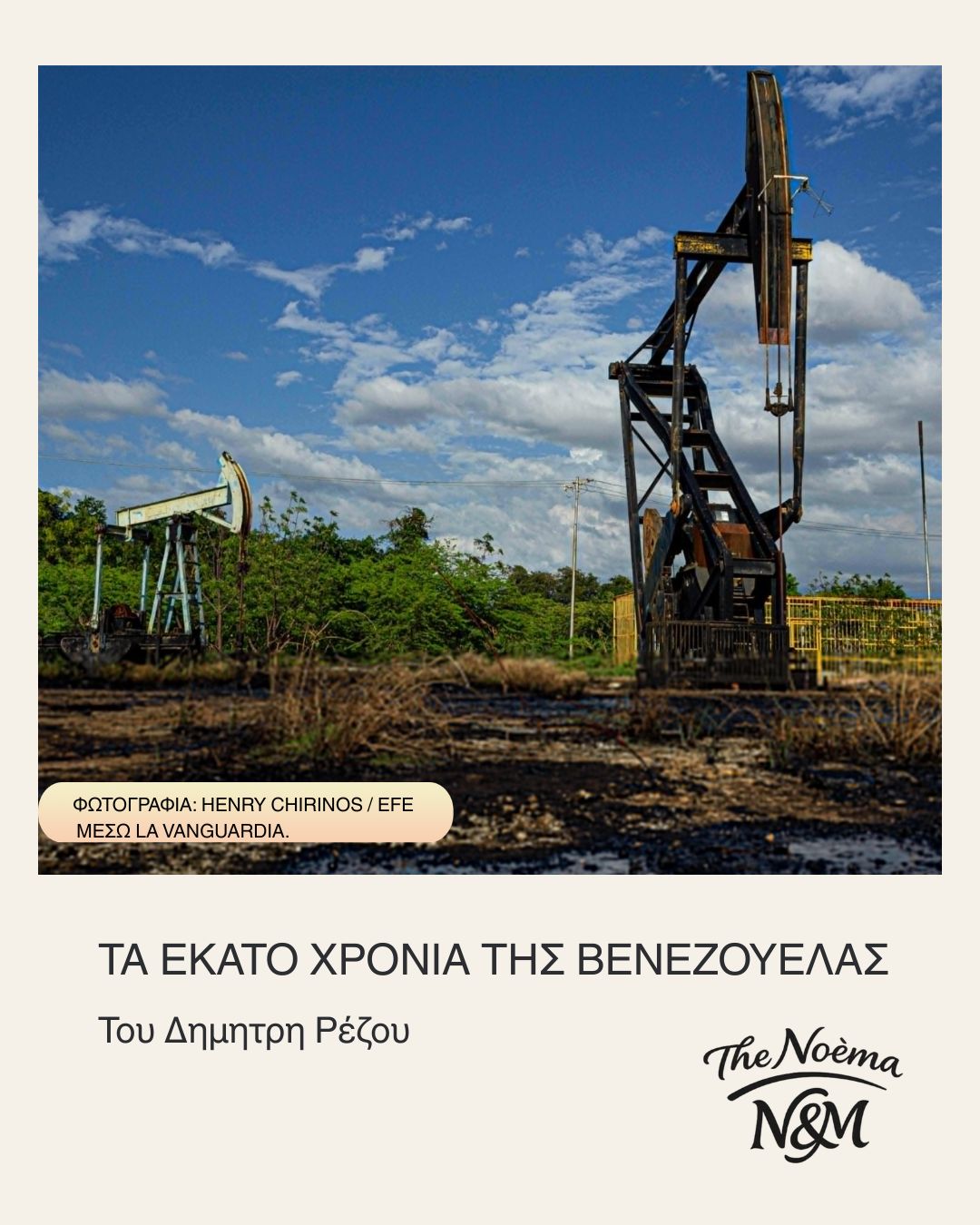
From the condemned generations of Latin America to Donald Trump’s 65 billion barrels. A deal that could prove seismic for the energy map — or just another one of Trump’s grand poses.
On November 9, 1830, Simón Bolívar is in Barranquilla, ill, politically defeated, with Gran Colombia breaking apart before his eyes. He is 47 years old — not old in age, but exhausted and only a few weeks away from death, on December 17. He writes to General Juan José Flores and produces something like a reckoning with twenty years of revolution and power.
The famous phrase is:

«El que sirve una revolución ara en el mar.»
That is, almost word for word:
“He who serves a revolution ploughs the sea.”
Almost two centuries before Gabriel García Márquez condemned the Buendías to one hundred years of solitude, another man had described the same Latin American tragedy in a single sentence.
Márquez would later need an entire Macondo to describe what Bolívar had fitted into seven words: generations condemned to begin again from the start.
And perhaps that is why, in Latin America, one hundred years were never simply a number.
They were almost a contract.
Bolívar 1830 → Márquez 1967 → Rodríguez 2026.
A span long enough for children to be born, grow up, fight the agreements of their fathers, cancel them and rewrite them, promise that this time the country will take back what belongs to it and, after one or two generations, for the same dreams and the same expectations to return, the new revolutions and the new betrayals, until the descendants of those who once swore they would change History find themselves again at the same table, opposite more or less the same people, with more or less the same arguments — only the companies will have changed names and the signatures will now be electronic.
Gabriel García Márquez described it with far greater precision than any economics manual. The Buendías’ one hundred years of solitude were not simply the story of Macondo; they were an allegory of a continent where generations often seem condemned to repeat what those before them believed they had left behind for good.
That is why the 100 years now appearing in reports about Venezuela’s new oil concessions do not sound neutral at all.
They sound strangely familiar.
And the strangest figure in this story is not even Donald Trump.
It is Delcy Rodríguez.
Because Rodríguez did not suddenly appear after Nicolás Maduro’s arrest as some temporary technocrat called upon to manage a country in transition. She is one of chavismo’s most characteristic figures, vice president since 2018, former foreign, economy and oil minister, with such a concentration of power that Reuters notes the nickname “tsarina”. Her father, Jorge Antonio Rodríguez, was a left-wing guerrilla and founding member of the Socialist League and died in 1976 while in custody, after alleged torture.
It is hard to imagine a denser historical irony.
The daughter of a man who died in conflict with Venezuela’s old political system, the woman who spent her own political life defending the Chávez and Maduro regime against Washington, now appears to be presenting as “historic” an energy agreement with the United States, only seven months after the American operation that led to Maduro’s arrest and removal.
There is no need yet for the word “betrayal”. The image itself does more work.
Because between the father of 1976 and the daughter of 2026 fits almost the entire political memory of modern Latin America: revolutions that became governments, governments that became systems, systems that learned to bargain with those they once swore they would expel and, always somewhere at the centre, the same thing — the land, the minerals, the oil, the copper, whatever lies underneath and is valuable enough to change governments above.
Iquique and nitrates belong to another era and there is no need to distort history to bring them all the way to Caracas. The memory of a region in which natural wealth has for more than a century been a field of conflict between states, foreign capital and local elites is enough.
And then came Chile’s copper, when Allende made the nationalisation of the great copper industry a central question of national sovereignty and, in 1971, the Chilean Congress unanimously approved full nationalisation. The largest mines passed from American companies to the state.
And then, once again, History found its man.
Because this was not an innocent commercial dispute. The Nixon administration’s economic and political pressure on Allende was directly linked to copper nationalisation and to the American interests threatened by it. And in that climate, one of the men long regarded as loyal to the constitutional order, General Augusto Pinochet, whom Allende himself had appointed army commander only a few weeks earlier, found himself at the head of the coup of September 11, 1973.
There is no need to overload the analogy. The irony is enough: on a continent where revolutions often searched for their traitors inside the very mechanisms they thought they controlled, “loyal associates” could be transformed, in very little time, into the people who closed the circle.
And so, from Allende to Pinochet, the old Latin American pattern returned once again: dream, power, rupture, betrayal — and back to the beginning.
So there is no need to pretend that Venezuela in 2026 does not resemble Chile in 1973.
It does. And disturbingly so.
Only this time there is no copper but oil; there are no tanks climbing toward the presidential palace, nor a general turning his weapons against the man who trusted him. There is something else, adapted to a different era: a foreign power enters the country, arrests and removes its president and, a few months later, sits across from the successor authority to negotiate the country’s most important natural asset.
A coup of another type, one might say — not the military junta taking power and staining the streets with blood, but one in which the change in political reality comes first and the contract follows.
And here Delcy Rodríguez is more interesting precisely because she is not Pinochet.
She does not appear as a general overthrowing his leader, she has not yet stained her hands with the blood of a crackdown, and she does not even need to play the traitor in the classic Latin American way. She remains a child of the same political system, an heir to the same revolutionary tradition, and that is why her possible transition from guardian of chavismo to interlocutor in a hundred-year energy agreement with Washington is perhaps even more complex — and more modern.
Pinochet needed the coup to change the regime.
Rodríguez may need only a signature.
So, on August 28, Trump appears and announces an agreement covering 17 oil fields and approximately 65 billion barrels of reserves — more than one fifth of the country’s proven reserves — and calls it the biggest oil deal ever made. The agreement foresees a new corporate structure, with the American side appearing to acquire 55%. Rodríguez says something different.
She speaks of a 25-year bilateral plan, the development of the same 17 fields, a production target above 1.5 million barrels per day, and insists that Venezuela retains sovereignty over its natural resources.
And here literature must stop for a while and Márquez must leave the room, sit outside and wait.
Because from here on, the numbers speak.
THE DEAL | WHAT WE KNOW
THE ASSET
17 oil fields ≈ 65 billion barrels of proven reserves
More than 20% of Venezuela’s total reserves
THE INVESTMENT LEG
≈ $100 billion in projected foreign investment
Production target: above 1.5 million barrels per day
Development timeline: unknown
Committed capital: still unclear
WHAT VENEZUELA SAYS
Duration: 25 years
Projected state revenue: ≈ $209 billion
Rodríguez insists that ownership and national sovereignty over natural resources remain with Venezuela.
WHAT THE AMERICAN SIDE SAYS
Access to 55% of actual production
Oil purchase rights, including possible diversion to US strategic reserves or military needs
Concessions lasting up to 100 years have also been reported
THE PROBLEM
25 years ≠ 100 years.
Ownership ≠ control of production.
65 billion barrels underground ≠ 65 billion barrels immediately and economically recoverable.
$100 billion in projected investment ≠ $100 billion in already committed capital.
$209 billion in projected revenue ≠ $209 billion in guaranteed revenue.
And, most importantly, the full legal and financing framework of the agreement has not yet been made public while
the full legal and financial package has still not been published.
At this point Márquez may return. And, if he wants, Trump too, for the show.
Because IF the key terms being leaked are confirmed, IF the required private capital is indeed secured, IF companies agree to return to an oil infrastructure that has suffered decades of underinvestment, and IF the legal concessions survive challenges and future governments, then perhaps we are watching something much larger than an oil agreement.
Perhaps we are seeing the first act of a seismic rearrangement of the Western Hemisphere’s energy map.
For Washington, the timing could hardly be better. The same administration that is mired in a prolonged war with Iran and in a new era of energy uncertainty suddenly gains privileged access to one of the largest concentrated oil assets in the world. And Venezuela, from a security problem in America’s “backyard”, could become an energy reserve of major strategic value.
That would be a geopolitical earthquake.
But there would also be something else inside it, much harder to pass over.
The government agreeing to these terms is the government that emerged after the American operation that removed the previous president.
And it is, by definition, a transitional government. It has itself pledged that the political transition will be completed with elections. Until then, however, it lacks precisely what Washington had for years cited as the fundamental problem of Maduro’s rule: fresh electoral and democratic legitimacy.
Here the irony becomes difficult to ignore.
Maduro was removed within a narrative built, among other things, on restoring democratic order, popular sovereignty and — the now familiar invocation — Western values. And yet, before the Venezuelan people have even been called to elect those who will govern them in the new era, the transitional authority appears to be negotiating terms that may determine the exploitation of the country’s most important wealth-producing resource for many decades — possibly for an entire century.
The question, therefore, is not only whether the agreement is economically advantageous.
Before that comes who has the democratic mandate to sign it.
Because there is a paradoxical proportion between a government that knows its term is temporary and a concession that could outlive not only that government itself but four or five generations of Venezuelans.
And somewhere here the word “hundred” returns.
No longer as Márquez.
As the duration of a contract.
While the woman defending and celebrating this contract is one of the most powerful political heirs of the regime that for decades built its legitimacy precisely on resistance to American influence and the defence of national sovereignty over oil.
That is why the real question for Rodríguez is not whether $100 billion sounds like a lot.
It is another: how freely does a temporary leader negotiate with the country that, only a few months earlier, removed her predecessor from the presidential palace?
The answer is not yet in her statements.
Nor in Trump’s statements.
It is in the terms.
In the voting rights. In the participation share. In the purchase price. In the dispute-resolution mechanisms. In the jurisdiction governing the contracts. In the termination clauses. In who finances capital expenditure, that is, the required investment.
And above all in what exactly happens when a future government in Caracas decides, perhaps in ten or twenty years, that it no longer likes what Rodríguez signed in 2026.
Because then we will also learn what 100 years really mean.
For now, however, there is also the other possibility.
Far less epic and far more Trump.
That what we have before us is a gigantic announcement, with 65 billion barrels, $100 billion in investment, $209 billion in revenue, a triumphant White House and a corporate structure that has still not been shown to be financeable, workable, legally durable or capable of producing on the timelines implied by the political statements.
And so, perhaps for the first time, the correct journalistic stance toward a huge Trump “deal” is the simplest one:
not to rush either to glorify it or to ridicule it.
To wait.
If it is confirmed, it may be one of the largest geopolitical shifts in Latin America in decades.
If it is not confirmed, it will be one more monumental scene in Trump’s political theatre — a Deel™ as large as it needed to be to fit inside it a headline, 65 billion barrels and a few weeks of political communication.
But in Latin America there is a problem with big words and big contracts.
Sometimes they last longer than the people who signed them.
And one hundred years is a long time for a country.
Πρόσφατα στην ίδια κατηγορία