
When an opinion piece in the Financial Times invokes Salvador Allende to speak about Nicolás Maduro, this is not romantic historiography.
It is neither nostalgia nor ideological flirtation with the past.
It is risk signaling.
The Financial Times is not a newspaper of outrage. It is the paper of markets, elites, and so-called “rational stability.” When such an outlet activates 1973, it does not do so to stir emotion; it does so because the system recognizes patterns it does not wish to see repeated—yet must prepare for.
When the FT speaks through historical analogy, it does not shout.
It whispers where it matters.
Allende was not simply “a left-wing president.” He remains the trauma of the post-war liberal narrative: democratically elected, overthrown with documented political, economic, and covert U.S. involvement, with strategic natural resources at the center—copper then, oil now.
When the Financial Times opinion underscores that strategic natural resources lay at the core of American interests, it speaks to two audiences simultaneously:
- to the older generation, carrying memory, fear, and déjà vu
- to the younger, who understand that geopolitics is not abstraction but conflict over material interests with tangible cost
That awakens. And yes—it sends a chill.
Because it normalizes the comparison, strips it of the label “conspiracy,” and shifts the debate from the moral to the structural: not “good or bad Maduro,” but how power operates when resources are at stake. At the same time, it prepares both public and elites for harsher developments ahead.
Politics as a safe zone
Contemporary neoliberal politics operates under an unspoken pact: say much, but name no one. Speak of “structures,” “systems,” “climate.” Never of individuals. Politics thus becomes safe—and precisely for that reason, harmless.
Violence becomes “excess.”
Repression becomes “necessary measures.”
Inequality becomes “structural dysfunction.”
Not who did this, but the system failed.
A language that preserves moral unease while removing political cost.
Naming, by contrast, is always a dangerous act. It concerns not only what you say, but where you place the conflict.
Mamdani’s rupture
In this environment, Zohran Mamdani breaks the pact.
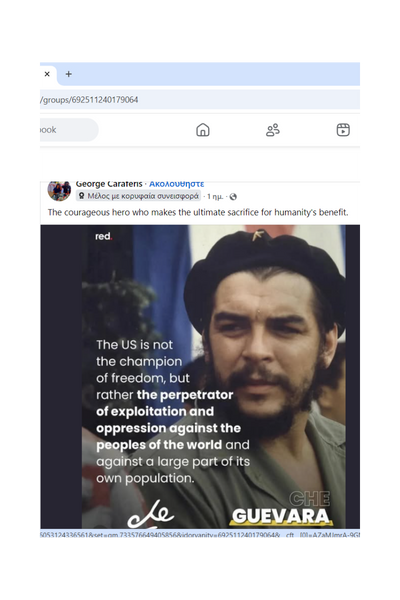
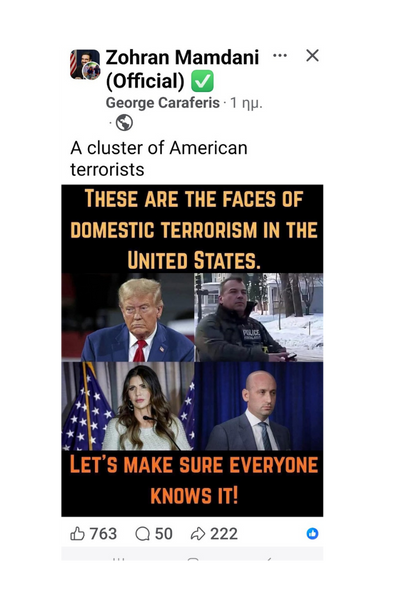
In the immediate aftermath of the murder of Renee Goode in Minnesota, a post appeared on Mamdani’s verified official page explicitly naming specific individuals (Trump and close associates) as faces of domestic terrorism. Shortly thereafter, another post appeared featuring Che Guevara, captioned: The U.S. is not a Paradise of Freedom.
These posts were not personally authored by Mamdani, but by a member of his page’s management team. Yet on verified political accounts, nothing appears—or remains—without administrative approval. Non-removal is not neutral hosting of third-party views; it is active acceptance of presence within the political environment of the page.
In media terms, this is called strategic tolerance: not personal identification with a position, but a conscious choice of framing and discursive boundaries.
With this acceptance of frame, Mamdani is not merely provoking. He is attempting a narrative inversion. He takes a term long used by power downward—as a tool of discipline against movements and minorities—and returns it upward, toward figures of authority and mechanisms that legitimize fear.
Here, the term operates rhetorically, not as legal accusation, but as political naming.
The discomfort this produces is not only about content. It is about violation of discursive hierarchy: who gets to define what “terrorism” is.
By naming individuals, political language shifts from safe commentary to frontal confrontation. The question ceases to be “is there a problem?” and becomes “who produces it?”
Naming, responsibility, risk
Liberal democracy presents itself as a system of checks and balances. Institutionally, this often holds. Politically and socially, however, responsibility diffuses. Public debate becomes ritualized.
In this context, naming functions as a moral interruption: it halts the flow of normality and forces discourse to take a stand.
Yes, it carries dangers—simplification, populism, demonization. But the alternative, permanent avoidance, produces a democracy incapable of hearing its own fractures.
Politics that refuses to risk naming ultimately becomes mere management.
Institutional guerrilla warfare
Mamdani is not making “left-wing noise.” He is playing a full strategic game:
- He is elected within the system
- He speaks anti-systemically without crossing legal thresholds
- He deploys symbols—ICE as internal enemy, Che Guevara as image of rupture
- He chooses social media as the primary battlefield, not legacy media
This is not activism. It is institutional guerrilla warfare.
Che—sanitized as an image and redeployed by an elected institutional actor—does not function here as a call to armed struggle, but as an ironic indicator: rupture will not come from outside; it will come from within.
Mamdani no longer seeks broad social consensus. He is not Martin Luther King Jr., the safe symbol of non-violent unity. He builds a core, not a majority.
He plays frontline politics, knowing he will be targeted, accused of excess, made to pay real costs. Yet he bets that the conversation is worth the price.
Either it lifts him—or they will “end him brutally.”
Closing
If the Financial Times resurrects Allende as a warning to elites, Mamdani resurrects Che as a provocation within political language itself. Not necessarily to glorify rupture, but to make it thinkable again.
History suggests that politics does not evolve when everyone speaks carefully, but when some speak dangerously—not because righteousness overwhelms them, but because they force society to look where it prefers not to.
Perhaps that is the real fear behind such interventions.
Not that they exaggerate.
But that they break the silent pact of harmless politics.