
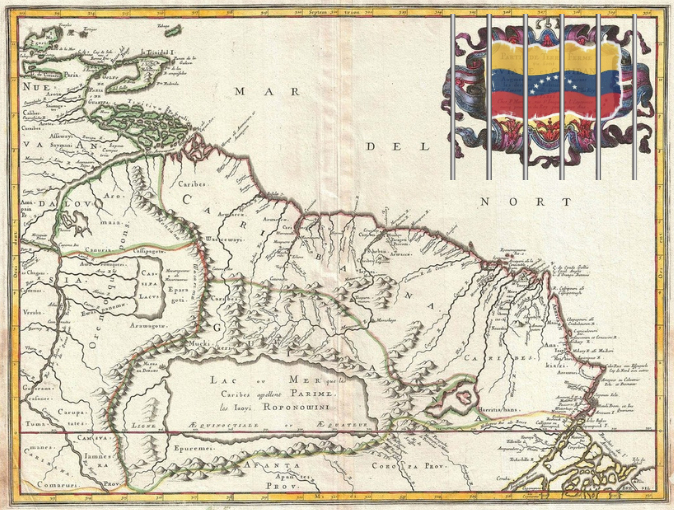

On January 3, 2026, the United States carried out a military operation inside Venezuela and detained Nicolás Maduro, transferring him to New York to face criminal charges. Two days later, on January 5, Delcy Rodríguez was sworn in as interim, transitional president, with the backing of key institutions and the armed forces, while Maduro appeared before a U.S. court. Inside the country, a state of emergency was declared, colectivos and internal security mechanisms were deployed, and the international press began reporting arrests, intimidation of the population, and the “detention of journalists.”
What almost no one openly addressed was the central question: does this constitute a change of power?
The dominant picture is not rupture but ambiguity. No one speaks openly of a coup, yet neither is there acknowledgment of a violent break that created a true power vacuum. The governing system appears to be attempting to reproduce itself without Maduro, preserving the coherence of the apparatus while shifting the figure at the top. Delcy Rodríguez is neither an outsider nor a technocratic stopgap. She is a core figure of chavismo, an organic component of the regime itself. The critical question, therefore, is not whether she merely “holds” power temporarily, but whether she functions as a bridge toward a controlled transition—or as a successor who preserves the system intact while changing only its façade.

Institutionally, the framework is blurred. References to interpretations of “temporary absence” allow the extension of provisional rule without a clear timetable. The opposition finds itself in a paradoxical position: it possesses a narrative of legitimacy—elections, international recognition in the recent past—but real power on the ground currently runs through the military, the judiciary, and the security apparatus. The immediate question is not “who won,” but who can govern without plunging the country into bloodshed.
From Washington’s perspective, the operation is presented as regime removal framed as law enforcement: arrest, transfer, trial. Internationally, however, the reading is different. This was a unilateral military action with enormous precedent-setting implications, justified through legal and moral arguments that convince few beyond the U.S. domestic audience. The European Union shows no appetite to follow. The United Nations will not legitimize it. There is no international consensus comparable to 2003. And this is not Iraq. Venezuela is not militarily “easy”: jungle geography and dense urban terrain, a military experienced in internal control, and colectivos functioning as a para-state arm.
The elephant in the room is, of course, oil. Markets and analysts are already reading events as a potential pivot toward a restructuring of Venezuela’s oil sector, with medium- to long-term scenarios of increased production should the sanctions and investment framework change. At the same time, PDVSA is moving toward production cuts due to immediate export obstacles and the ongoing embargo, generating short-term pressure rather than any immediate “boom.” In the United States, refineries dependent on heavy crude are watching developments closely, while the role of Chevron and special licensing waivers is emerging as a possible focal point of political bargaining.
If Washington attempts a rapid oil restructuring without domestic political legitimacy inside Venezuela, it risks insurgent responses, infrastructure sabotage, and intensified repression. The wager is not technical; it is political.
Reading the international media coverage, one can detect—beyond propaganda, which is a necessary instrument—the deliberate cultivation of ambiguity as a technique to cover a void: the collapse of a narrative built over years. When outlets such as The New York Times or The Financial Times report that “Rodríguez and her brother held talks with the United States last year,” without names, roles, institutional capacity, documents, or chronology, this is not naïveté. It is journalistic ambiguity that allows political reconstruction after the fact. Here, ambiguity is not absence; it is a space for maneuver.
There was a narrative: “Maduro is authoritarian.” Instead of the more complex and politically uncomfortable reality—that he was pressured, isolated, coerced, and that an entire country was economically strangled. These are not the same thing. And they are not neutral descriptions.
It is precisely here that the familiar, almost automatic moral superiority inserts itself as a substitute for analysis. Even credible, “radical” outlets, with all the intellectual culture they invoke, often fall into the trap of conflating moral positioning with geopolitical power analysis. They confuse permissiveness with freedom, rights-based discourse—whether around identities or specific social claims—with the actual distribution of power on the ground. That is where the analysis collapses.
Thus, one can encounter—without any perceived contradiction—the argument: “The U.S. invasion of Venezuela was wrong, but there is dictatorship and drugs there threatening society, therefore it was justified,” while, at the same time, Russia’s invasion of Ukraine is categorically condemned because Russia “should not have felt threatened” by NATO weapons at its doorstep. Power, however, does not operate through pure intentions or morally consistent narratives.
What these arguments obscure is the reality of power on the ground. The darkest scenarios do not emerge from a single decision at the top, but from erosion within the apparatus itself. Fractures within chavismo or the military could lead to fragmentation of authority, with security groups and colectivos acting increasingly autonomously, producing violence and instability without central control. At the same time, the conflict could be externalized: weaponization of oil, sanctions, and borders; increased migration flows; expanded smuggling; and low-intensity incidents that export the cost of the crisis beyond Venezuela.
Within this framework, scenarios for the next 30 to 180 days differ less in personalities than in the degree of rupture with the existing system. The most likely outcome is a regime of controlled continuity: Rodríguez maintains the apparatus, opens limited channels of “dialogue” outward, but the core of power remains essentially intact. A second, more difficult but politically optimal scenario would be a negotiated transition, involving segments of the opposition and the military, a clear electoral timetable, and some form of international oversight. These two outcomes are neither equivalent nor neutral; they imply different levels of confrontation with the existing power structure.
In any case, what is at stake is not merely who will manage the next phase, but whether the void left by a failed narrative will be filled by a political solution—or by more force.
Power does not operate through pure intentions. It operates through interests, coercion, and silence. That is why the central hypothesis being tested now is not military but political. If, in the coming hours or days, there is no mass popular mobilization, no emergence of a new leadership pole with real social weight, and if the regime maintains control without bloodshed, then the foundational assumption collapses: that “the people are ready, merely waiting.”
If this momentum does not materialize, the problem is not communicative; it is structural. Venezuelan society is exhausted. It has migrated en masse. It has been burned by false moments of change, such as that of Juan Guaidó. This does not produce uprising; it produces inertia. And that inertia is something many Western analyses are unable to read.
When social pressure and oppositional legitimacy fail, history leaves only three paths: acceptance of stagnation, negotiation with the existing regime, or externally imposed change. The last includes targeted operations, prolonged sanctions, economic strangulation, the creation of parallel institutions—and, if violence occurs, its framing as “internal.”
If it is confirmed that the narrative of popular uprising was wishful thinking, then any escalation that follows will not be “for democracy,” but to cover a strategic failure. It was not an operation that failed; it was a narrative built over years—the idea that society was boiling, merely awaiting a leader for the regime to collapse.
The core misreading was the confusion of discontent with readiness for revolt, poverty with political mobilization, anti-Maduro sentiment with trust in the opposition. Venezuelan society was not waiting for Guaidó, nor for María Corina Machado—not out of ideological blindness, but out of experience. Out of dignity. Out of collective memory shaped by a harsh colonial past. When you have been burned two or three times, you do not take to the streets for narratives. You do so only when you believe something will truly change.
And this is the point where every “exported” narrative of democracy, order, and security hurts the most: when society refuses to play the role written for it.