
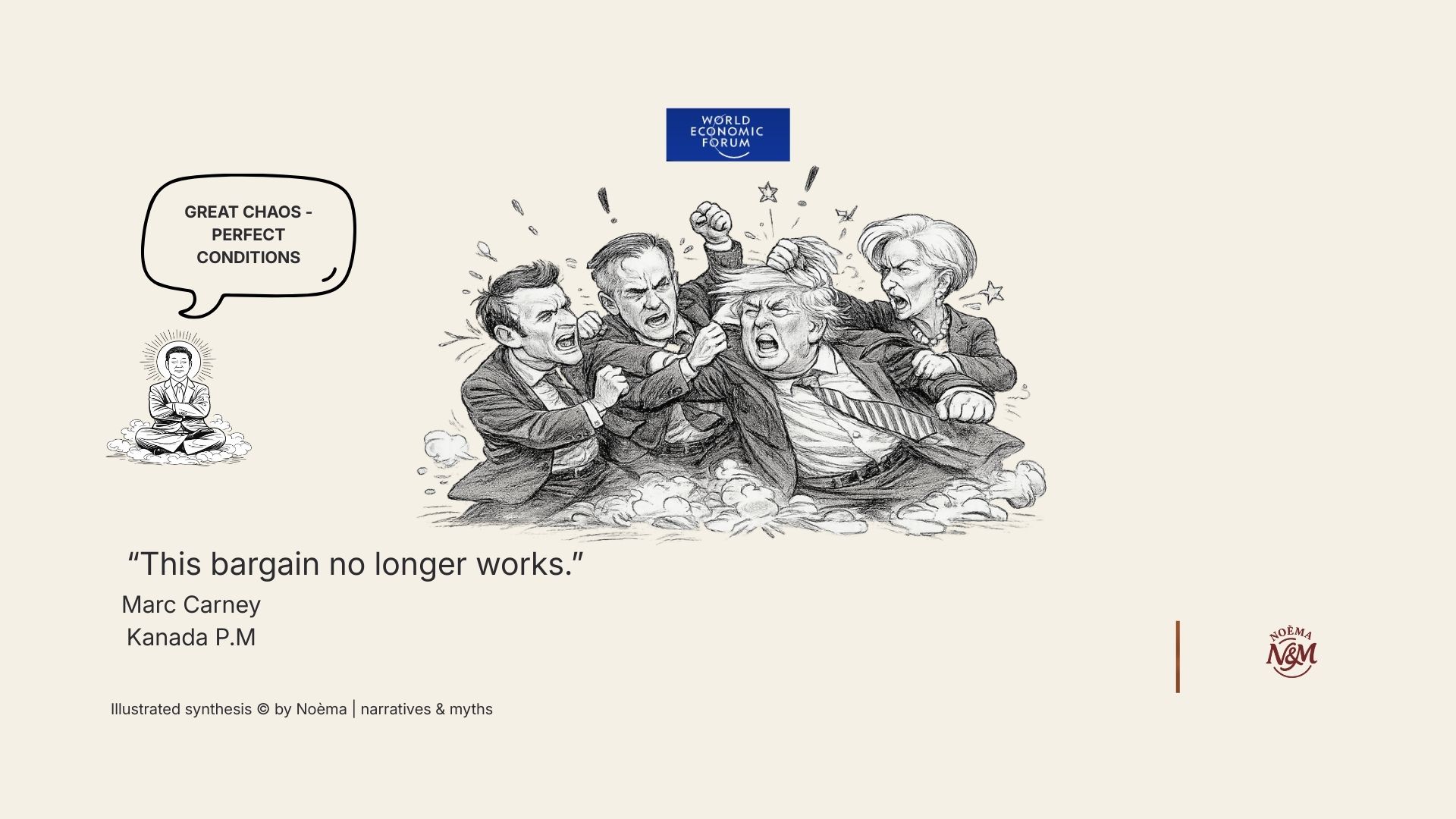

A cynical confession of failure, stripped of any trace of self-criticism.
At Davos 2026, this line surfaced in the speech of Canada’s Prime Minister, Mark Carney.
For the first time in decades, a supposedly credible institutional figure publicly admitted that we had been living inside a lie sold to the world as a “rules-based order,” as if it were a new Revelation in international politics.

What Carney forgot to mention is that this lie — especially in the last decades — was kept alive by himself and the entire chorus around him through hundreds of books, articles, and think-pieces praising “progressive globalization.”
Even as the system was leaking from every seam.
Even as exceptions became the rule.
Even as they wrote the rules with a marker that only they could see.
Why?
Because the narrative was convenient.
Because it suited them.
Because it gave them a role.
Because it dressed their hollow rhetoric in the costume of “thought leadership.”
Because the West — with few exceptions — entrusted its future to the worst leadership class, the corporations, and the weakest institutions of the post-war era.
And now, when Carney dared to acknowledge the fracture, it wasn’t just an observation.
It was the declaration of an era’s end.
An era that effectively closed when the ECB President walked out of Larry Fink’s dinner — Fink being the powerful CEO of BlackRock — while European officials hurled chairs and booed Trump’s Secretary of Commerce, the Governor of California was “disinvited” after White House pressure, and Canada’s Prime Minister told them to their faces that they had lived inside an illusion for decades.
The “bargain” was simple:
the US provides security,
the West aligns behind the American footprint,
markets operate under an American umbrella.
In short, Carney announced that the 1945–2016 contract has collapsed, and that the age of unipolar dominance has officially ended.
With a kind of surgical eulogy, Carney delivered the hegemon’s tacit concession of defeat.
His proclamation of the end of the rules-based order targeted the entire architecture built after 1945 — a structure that was never fair, never applied evenly, and never truly governed by the same rules for everyone — only by power.
And that is a near-heretical demythologization for the Davos forum.
Because rarely does an elite publicly admit what everyone else has seen for decades:
that globalization was an American architecture,
that the “order” was a cover for interests,
and that the system itself now acknowledges the end of its era.
Carney’s line is the equivalent of saying:
“We know we’re finished — and we’re telling you plainly.”
“This bargain no longer works” wasn’t a description of policy failure; it closed a historical cycle.
The deal that held the post-war West together — security in exchange for deference to the American imprint — no longer has an audience, nor a mechanism for enforcement.
When Carney aimed the blame “photographically” toward Trump΄s administration he wasn’t seeking a scapegoat. He was publicly legitimizing what has been whispered for years: Trump didn’t destroy a stable order; he exposed an order that had already rotted.
And with two sentences, Carney dismantled the myth of the rules-based order more effectively than volumes of theory. Davos heard, from one of its own offspring, what it never wanted spoken in daylight.
The real weight of Carney’s statement lies not in the words but in what he admitted implicitly: that the West was built on a series of convenient mythologies maintained by elites for as long as they benefited from them.
The “rules-based order” was never an order — it was a euphemism for the unhindered circulation of capital, the asymmetric power of great economies, and the institutionalized tolerance of their abuses.
Carney merely inserted the final piece: the age of American unipolarity didn’t collapse accidentally or abruptly; it was systematically undermined by the very practices that claimed to rationalize the world.
And here begins the real problem: when the system itself confesses that its narrative has collapsed, the power vacuum that follows is not theoretical — it is material.
Small and medium-sized states no longer exist inside a “protected structure” but inside a geopolitical wind-tunnel where rules apply only to the weak, while the strong negotiate their exemptions as privileges.
The coming era will not be fairer; it will simply be more honest about the raw nature of power.
Of course, Carney did not experience any moral awakening. Nor was he suddenly struck by concern for justice.
If there is one point where the hegemonic and post-hegemonic eras expose their true face, it is in the fate of the small, the weak, the economically strangled — those who, for thirty years, handed over their economic sovereignty, shackled themselves, and embraced financial giants who exploited or humiliated them at will.
From Greece to Sri Lanka, and from Argentina to Tunisia, small states were forced to surrender fragments of their sovereignty in exchange for “stability” that never came.
It is no accident: the system needs test subjects to sustain the illusion that it still functions.
And the small — without market weight, without strategic reserves of power — pay the bill for the decline of the large.
In a sense, Trump may well be the darkly humorous, malevolent form of History’s revenge upon these people.
Without a stable system, without guarantors, without the old American “protection signal,” small economies now become the testing ground of the new global asymmetry.
Where once the rules formed a nominal safety net, they now function as an instrument of coercion: the strong are exempt; the weak comply — and we, the Middle Powers, must unite. That is Carney’s real call.
Let us not fool ourselves, as the major media and their intellectual commentators urge us to believe in the benevolent intentions of a new “Middle-Power Deal.”
There was no “moral awakening” in Carney’s statements.
No late conscience.
No elite self-critique.
What spoke was fear — fear of the monster that Western leadership itself nurtured for decades.
That monster now has a name, a mass audience, and electoral momentum.
Trump is not the problem; he is the mirror they refused to look into.
In a sense, Trump may well be the darkly humorous, malevolent form of History’s revenge upon these people.
And when the scream finally echoed through Davos, it wasn’t a warning to the world — it was a warning to themselves.
And yet Carney — instead of turning to Brecht (“when the Nazis came for your neighbors you said nothing; now that the Beast comes for you, there is no one left to care”) — chose the safe, sanitized example of Havel.
A Havel stripped of his real depth, used as rhetorical cover.
Why?
Because, subtly, he had no intention of letting our minds wander freely; he wanted to remind us once more of the old incantation elites repeated for decades to shut down every conversation before it began:
“There is no alternative.”
Now, however, there is an alternative: the chaos they themselves allowed to accumulate.
And that is exactly what terrifies them.
History rarely forgives the myth-makers who refused to face reality when it stood right before them, nor the magicians who run in panic from the demons they themselves conjured.
Sources:
➡️ Rev.com transcript (ελεύθερη πρόσβαση μεταγραφή)
🔗 https://www.rev.com/transcripts/carney-at-davos
➡️ SchizophonicMusic Substack (με εκτενή αποσπάσματα της ομιλίας)
🔗 https://schizophonicmusic.substack.com/p/marc-carney-complete-speech-at-davos
➡️ Reddit / GlobalNews transcript link (αναδημοσίευση πλήρους κειμένου)
🔗 https://www.reddit.com/r/geopolitics/comments/1qiax6i/read_the_full_transcript_of_carneys_speech_to/
📍 World Economic Forum — highlights quotes (“This bargain no longer works…”